This iPhone 14 died without warning. The 5V rail took the power IC with it.
No drop, no water, no warning. The phone was working one minute and completely dead the next. On the bench it turned out to be a hard short on a high-current 5V rail, caused by a capacitor that had failed internally. By the time it came to us, the short had already taken the power management IC with it. Replacing that chip is the single riskiest thing you can do to an iPhone board, and here's why.
Not in the GTA? We accept mail-in recovery from anywhere in Canada
What the owner saw
- Working, then deadSet it down fine, picked it up unresponsive
- No accidentNever dropped, never near water
- Completely darkNo Apple logo, no vibration, no haptics
- Nothing on a chargerNo charging screen, no warmth, no response
What we found
- Dead short to groundOn a high-current 5V rail
- A failed capacitorShorted internally, scorched the board around it
- Power IC damagedThe fault took the regulator with it
- Storage untouchedEvery photo still intact and readable
There is a particular kind of panic that comes with a phone dying for no reason. When you drop one, or drown one, at least you know what happened. This owner set an iPhone 14 down working and picked it up dead. No Apple logo, no vibration, no response on a charger. Nothing at all.
Two years of photos were on it. No backup. And the honest answer at the counter is that a phone like this is either a twenty-dollar component or a write-off, and you cannot tell which until you open it up.
This one turned out to be the worst version of the good outcome: a fault small enough to fix, that had already spread to the one chip you least want to touch.
Phones almost never die for no reason. What looks like "it just stopped" is usually a component that failed internally and dragged an entire power rail to ground. Here is what that actually does.
What a shorted 5V rail actually does
A modern iPhone runs a dozen different voltage rails. Most of them are low current lines feeding small circuits. The 5V rail is not one of those. It's a high-current line, and when a capacitor sitting on it fails short, it creates a direct path from a high-power supply straight to ground.
The phone's protection circuits react by shutting everything down, which is why the device goes completely dark rather than showing a low-battery screen or a boot loop. But protection isn't instant, and it isn't perfect. In the moment before shutdown, that short is dumping current through a very small area of the board, and that energy has to go somewhere. It goes out as heat.
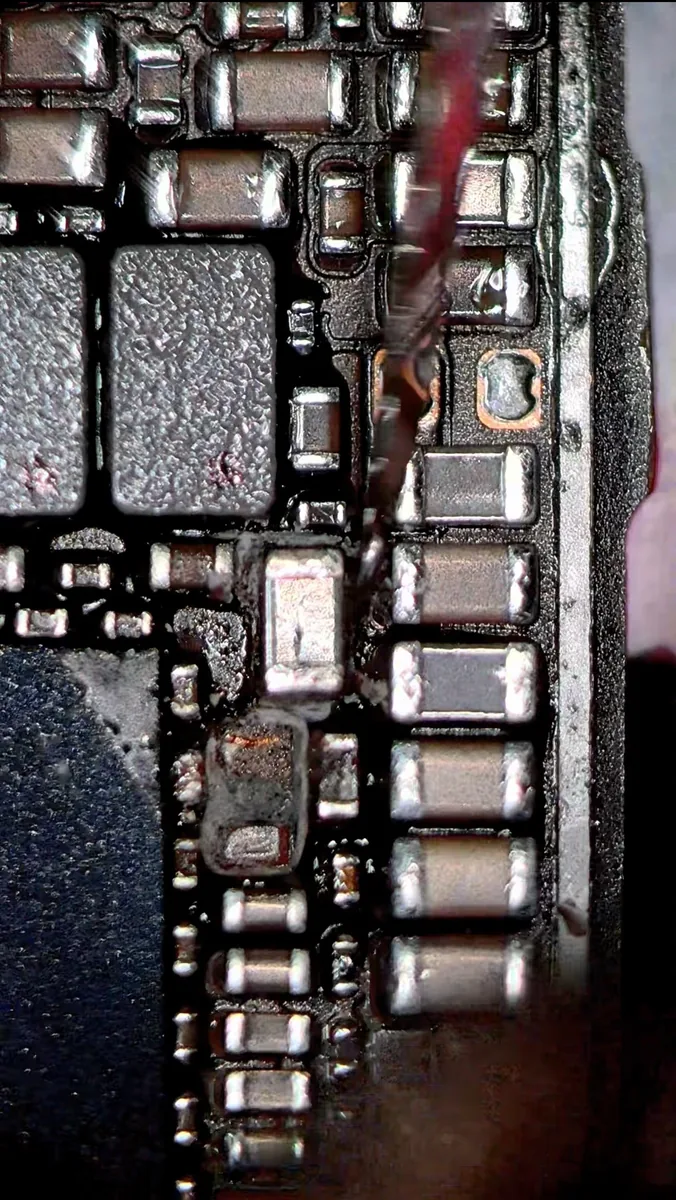
The short didn't stop at the capacitor
Replacing a shorted capacitor is routine work. If that had been the whole story, this would have been a quick job. It wasn't. The same fault had already damaged the power management IC, the chip that generates and regulates the voltage rails for the rest of the phone.
That's the difference between a cheap repair and a serious one. A capacitor is a component you lift off and put back. The power IC is a BGA chip: it sits on a grid of several hundred tiny solder balls underneath it, none of which you can see or reach once it's mounted. There's no repairing it in place. It has to come off the board entirely.
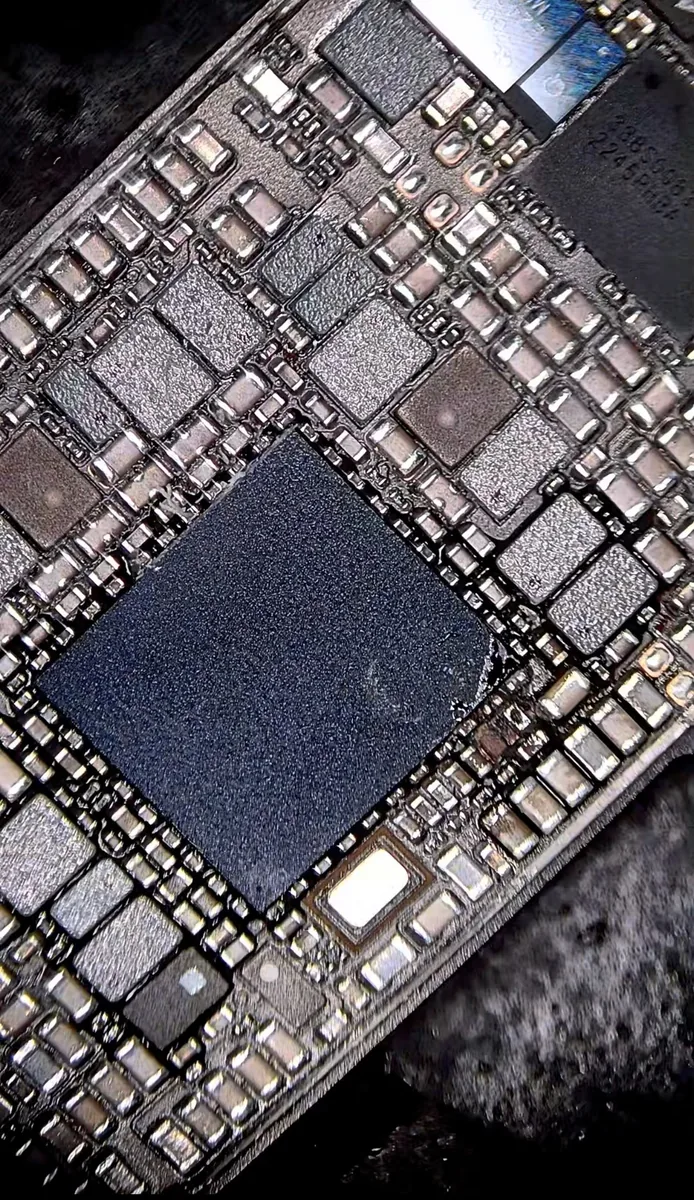
Why removing the power IC is the riskiest job on the board
Here's the part that makes this repair genuinely dangerous, and the reason a lot of shops won't attempt it.
To lift a BGA chip you have to melt every solder ball underneath it at once. That means driving hot air into a small area until the entire joint array liquefies. There's no gentle version of this. The chip does not come off until the solder is molten.
The problem is what's on the other side of the board. The CPU sits directly underneath. The board is thin, and heat does not politely stay where you point it. It conducts straight through the substrate to whatever is mounted on the opposite face. So while you're heating one chip to the point of melting, you are also heating the processor on the reverse side, and the processor is the one component on the entire board that cannot be replaced.
Get this wrong and there are two outcomes, both permanent. Overheat the CPU and it's dead, which means the phone is finished and so is the data. Or you disturb the CPU's own solder joints just enough that it lifts or shifts fractionally, and the phone never boots reliably again. In both cases there is no second attempt and nothing left to recover. The customer's photos go with it.
This is why "we'll just try reflowing it" is such a bad answer, and why heat guns and YouTube tutorials destroy so many recoverable phones. The margin between enough heat and too much heat is small, and you only get one pass at it.
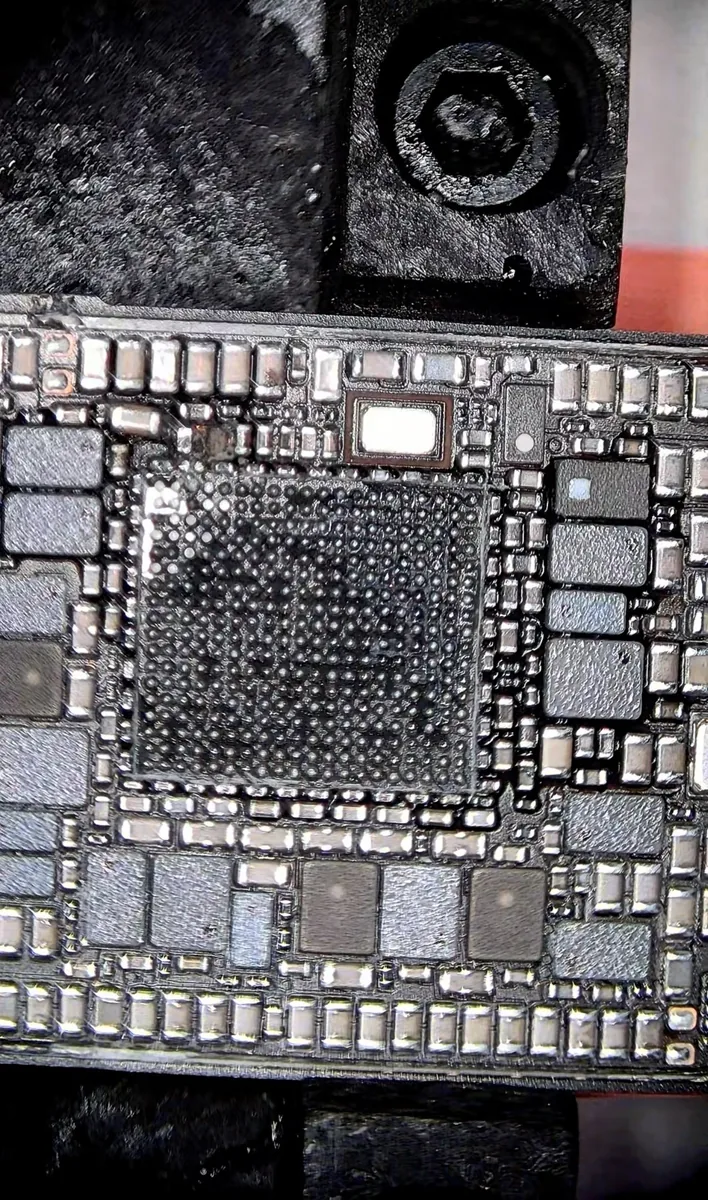
Reballing: rebuilding the chip's contacts
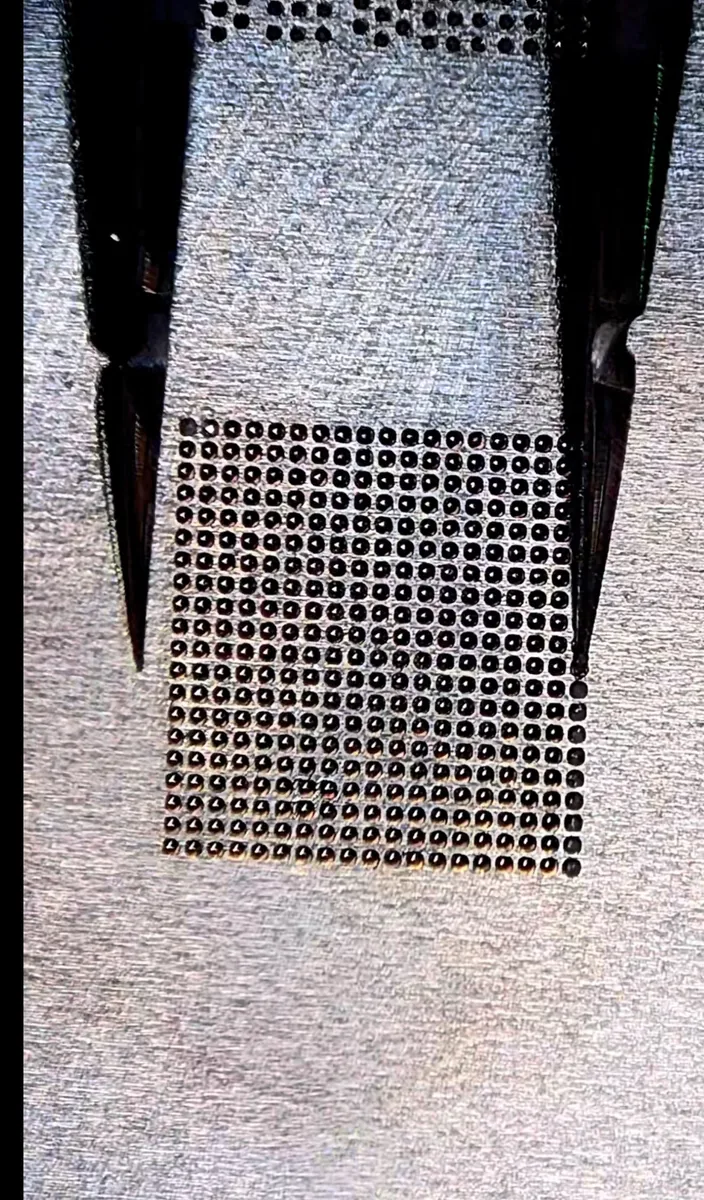
A removed BGA chip can't just go back down. Once it's off, the old solder balls are gone or deformed, so the chip has to be reballed: cleaned, placed on a stencil, and given a completely new grid of solder spheres.
Every single ball has to form correctly. One missing or merged ball and a rail doesn't come up, and you're back to a phone that won't boot, having spent another heat cycle on the board for nothing.
Why this is a data recovery, not just a repair
It's worth being clear about what was actually wrong with this phone, because it's the part customers find hardest to believe.
The storage was never damaged. The NAND chip holding every photo, message and contact was completely intact the entire time. Nothing was corrupted, nothing was erased. The data was sitting there the whole time the phone looked dead.
The problem was purely that nothing could power up to reach it. On a modern iPhone the storage is encrypted and tied to the specific processor and Secure Enclave in that device. You cannot lift the memory chip out and read it in another phone. The only route to the data is to make that board run again. Which is why the repair and the recovery are the same job.
That's also why a shop that gives up and offers you a replacement handset isn't solving your actual problem. A new phone is easy. The photos on the old one are the thing you can't buy back.
The result
New capacitor, reballed power IC back on the board, rails checked, and the phone booted. Everything intact, nothing lost, and the owner walked out with the original device rather than a replacement.
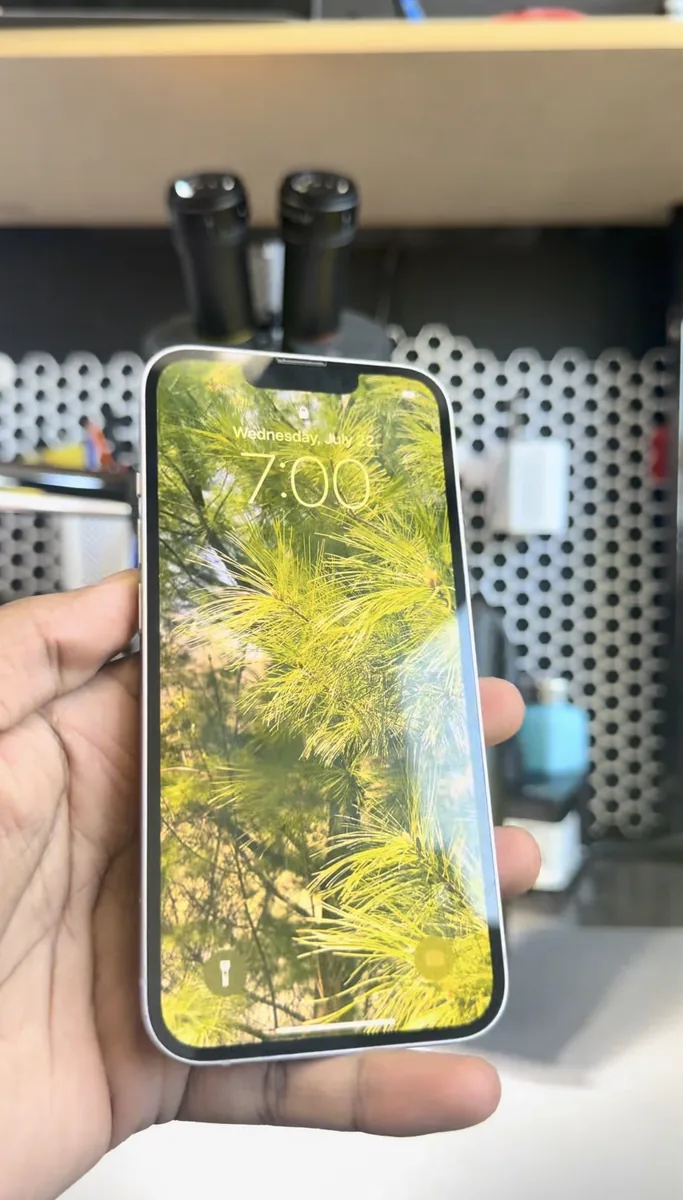
What to do if your iPhone suddenly dies
If a phone goes dark with no warning and no accident behind it, treat it as a board fault and act accordingly:
Stop plugging it in repeatedly. If there's a live short on the board, every attempt to charge feeds current back into the fault. That's more heat, and more damage, on a board that's already injured.
Don't let anyone "try a reflow." Blind heat on a board with a dead short doesn't fix anything, and each cycle brings the CPU closer to the edge. Ask specifically whether the shop does board-level micro-soldering in-house, and what happens to your data if the attempt fails.
Move quickly if there was any liquid involved. Corrosion is progressive. A board that's recoverable this week may not be next month.
Assume the data is still there. Dead almost never means erased. In the large majority of no-power cases we see, the storage is perfectly healthy and the only thing standing between the owner and their photos is a failed component worth a few cents.
What it costs and how long it takes
Board-level phone recovery of this type runs $120 to $480 depending on what failed and how much collateral damage the short caused. A shorted capacitor on its own sits at the low end. A capacitor plus a power IC replacement, like this one, sits at the upper end because of the removal, reballing and reinstallation work involved.
The diagnostic is free, you get a fixed price in writing before any work starts, and it's no data, no fee. If we can't recover it, you don't pay. Most of these jobs finish within 24 to 72 hours.
FAQ
My iPhone 14 died suddenly with no drop or water. Is the data gone?
Almost certainly not. A sudden death with no accident behind it is usually a power fault on the board, not a storage failure. The NAND chip holding your photos is typically untouched. The phone simply can't power up far enough to give you access to it. Once the faulty component is replaced, the data is normally all there.
Why can't you just move my storage chip to another iPhone?
Because Apple ties the storage to the specific processor and Secure Enclave in your device, and the contents are encrypted against that pairing. Moving the NAND into a donor phone produces unreadable data. The only way to your files is to repair the original board so it runs again.
What is a power IC and why is replacing it risky?
The power management IC generates the voltage rails the rest of the phone runs on. It's a BGA chip mounted on several hundred hidden solder balls, so it has to be fully removed and reballed rather than repaired in place. The risk is that the CPU sits directly underneath on the opposite side of the board, and the heat needed to melt the solder travels straight through. Too much heat and the processor is damaged permanently, which means the phone and the data are both gone.
Should I try a heat gun or a reflow myself?
No. Reflowing a board with a live short doesn't repair the fault, and every heat cycle stresses the CPU underneath. Most of the truly unrecoverable phones we see were recoverable before someone applied uncontrolled heat to them. If the data matters, don't spend your one attempt on a guess.
How much does iPhone 14 board-level data recovery cost?
Between $120 and $480 depending on the fault. A single shorted capacitor is at the low end. A capacitor plus power IC replacement is at the top end because of the removal, reballing and reinstallation. Free diagnostic, fixed quote before we start, and no data no fee.
Do you accept mail-in for this kind of repair?
Yes, from anywhere in Canada. We send a prepaid, insured label and quote a fixed price after the free diagnostic. See how mail-in works for the full process.
We recover data most shops can't reach.
We trace the fault, repair the board under the microscope, and get your files back off the original device. A dead iPhone almost always still has everything on it. Start with a free diagnostic, see a firm quote before we touch anything, and your data stays yours.