Controller drifting? Repair it, don't replace it.
We fix DualSense stick drift with TMR joystick modules — $70 per controller (both sticks included), lifetime warranty against drift. No more replacing your controller every 12 months. Here's what PlayStation 5 stick drift actually is, why TMR is the permanent fix, and what we charge to install it.
DualSense stick drift is mechanical wear inside the original potentiometer modules. We replace BOTH sticks with TMR (Tunneling Magnetoresistance) joystick modules — $70 per controller, lifetime warranty against drift. TMR sticks use magnetic sensors instead of physical contact, so there's nothing to wear out. New DualSense controllers run $90 retail, drift again in 12–18 months, and have no warranty after Sony's 1-year mark. The math is obvious.
Your character starts walking forward when you let go of the thumbstick. Your camera pans slowly to the right when you're not touching it. Aiming feels twitchy. Welcome to stick drift — the most common controller failure of the PlayStation 5 generation, and the one Sony spent two years pretending wasn't a real problem.
We see 6–10 of these per month at the bench. Almost every one is the same fix. Here's what's actually going on, what we do to fix it, and when you should consider replacement instead.
What stick drift actually is (it's not software)
Inside every DualSense controller, each analog stick sits on top of two tiny potentiometers — one for the X-axis (left/right), one for the Y-axis (up/down). A potentiometer is essentially a variable resistor — as you tilt the thumbstick, you physically rotate a contact wiper across a resistive strip, and the controller reads the changing resistance as your stick position.
Over thousands of hours of use, that contact wiper wears down the resistive strip. Tiny grooves form. Carbon dust accumulates. The reading becomes noisy — even when the stick is centered, the potentiometer sends false signals to the controller saying "the stick is at +5%" or "the stick is at -3%". The console reads those signals as you actually moving the stick.
That's drift. It's a physical wear issue, not a software glitch, not a calibration error. No firmware update fixes it permanently. No "deep clean cycle" repairs it. The potentiometer module physically has to be replaced.
Why DualSense controllers drift faster than older controllers
The DualSense uses the same Alps potentiometer modules as the DualShock 4 before it — modules originally designed in 2009 for game controllers expected to last 2–3 years of average use. Modern gaming sessions (streamers playing 8 hours a day, ranked grinders, MMO players) wear them out in 6–18 months.
You'll see videos suggesting compressed air or contact cleaner sprayed under the rubber boot will fix drift. It can buy you 2–6 weeks at most by temporarily flushing the carbon residue. The wear pattern doesn't go away — the resistive strip is still grooved. Drift will return, often worse.
Sony released the "PS5 Edge" controller with replaceable stick modules — an admission of the problem — but the standard DualSense still has soldered-in potentiometers that require desoldering and reflowing to replace.
How we fix it — TMR joysticks (the permanent fix)
We don't replace your worn-out potentiometer with another potentiometer that'll wear out again. We swap in a TMR (Tunneling Magnetoresistance) joystick module — the same magnetic-sensor tech used in premium controllers like the 8BitDo Ultimate and GuliKit KingKong.
The key difference: TMR joysticks have no physical contact between moving parts. Stick position is read by magnetic sensors detecting the angle of a tiny magnet at the base of the stick. There's nothing to wear out. No carbon dust. No grooved resistive strip. It can't drift — that's a physics statement, not a marketing one.
That's why we offer a lifetime warranty against drift on every TMR install. If a TMR stick we installed ever drifts, we replace it free. We've done hundreds of these. We've never had one come back.
The actual bench process
- Disassemble the controller. Back shell off, battery out, disconnect the LED ribbon cable, separate the front and back PCBs.
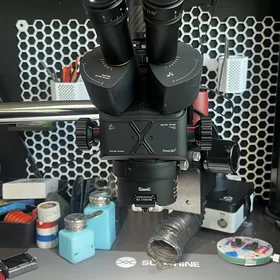
- Desolder the failed potentiometer module. 14 solder joints (4 grounding tabs + 10 signal pins). Hot-air station at 320°C, careful work around adjacent SMD components.
- Lift the old module + clean the pads. Desoldering braid, flux, surface prep for the new module.
- Install the TMR joystick module. Drop-in replacement for the original Alps footprint — 14 pins, same pinout. Solder all signal + grounding contacts.
- Reassemble + 30-min calibration test. Run the DualSense calibration sweep, verify the stick centers cleanly and tracks accurately through full range of motion in a real game (we test in Warzone or Apex).
Bench time: 45–60 minutes per controller (both sticks done together). Pricing: $70 per controller, both sticks included, with lifetime warranty against drift. We always do both sticks in one visit because the second one is usually within months of failing too — saves you a return trip.
Should you DIY this?
Honest answer: almost never.
TMR modules cost $20–30 each (vs $4–7 for stock Alps potentiometers), so two modules alone is $40–60 of parts cost. At $70 per controller for both sticks installed plus a lifetime warranty, the labour margin we're working on is small — not worth chasing on your own.
The risk: TMR module pads are surrounded by tiny SMD capacitors and resistors that are easy to knock off if your hot air aim is off by 2mm. We see at least one "I tried to fix it myself" controller per month that comes in bricked and needs trace repair on top of the install — that bumps the cost to $100–140.
If you have the gear and experience: TMR modules are sourced from GuliKit, ALPS, or HKR depending on availability. Budget 60–90 minutes for your first attempt. No iFixit guide we'd trust exists yet for TMR specifically — the standard guides cover Alps replacement only.
If you don't have the gear: $70 for both sticks installed with a lifetime warranty is the best deal in the entire PlayStation 5 ecosystem right now. There is genuinely no faster path back to a controller that won't drift again.
When repair doesn't make sense
There are exactly three scenarios where we'd tell you to buy a new controller instead:
- The shell is cracked or visibly damaged. The stick fix doesn't repair the shell. If you're going to replace the housing anyway, you're already most of the way to a new controller.
- The battery is dead or won't hold a charge. Battery replacement is another $40–60 service. Stack that on top of the stick fix and you're approaching new-controller territory.
- You've already drifted both sticks AND have a third issue (broken trigger, broken charging port, etc.). At that point you're paying $120+ in repairs on a $90 controller. Just replace it.
For everything else — especially a controller that's otherwise pristine but has one drifting stick — the $40–60 repair is the obvious play.
What it costs to fix (real GTA pricing, May 2026)
Why we don't do single-stick installs: The second stick on a DualSense usually starts drifting within a few months of the first one — same wear pattern, same playtime. Doing both sticks at once costs you $70 instead of $140 across two separate visits, and you're not back here in 3 months for the other side.
How long does a stick drift repair take in our shop?
Walk-in to walk-out: usually same day if you bring it in before noon. We keep replacement Alps modules in stock (yes, we burn through them weekly). Bench time is 30–45 minutes. Expect 3–6 hours total in shop including testing and queue time.
Mail-in (anywhere in Canada): 4–7 business days door-to-door. Includes diagnostic, repair, and 30-minute calibration test before we ship it back insured.
FAQ
Can software calibration fix stick drift?
Temporarily, sometimes. The PS5 has a built-in deadzone calibration that can mask very early drift by ignoring small movements. But the underlying potentiometer wear keeps progressing. Within weeks the deadzone needs to grow again, and your stick becomes less precise. It's a workaround, not a fix.
Will Sony fix my PlayStation 5 controller for free?
Sometimes. The DualSense has a 1-year manufacturer warranty in Canada. If your controller is under 12 months old AND you escalate (mention class action lawsuits), Sony will often replace it. Outside warranty, Sony's repair quote runs $80–120 plus shipping both ways and 3–5 weeks. We're faster and cheaper.
How long does the TMR repair last? Will it drift again?
TMR sticks don't drift. Period. They use magnetic sensors instead of physical contact — there's no resistive strip to wear out, no carbon dust to accumulate, no contact wiper to groove. The technology itself rules out the failure mode. That's why we offer a lifetime warranty against drift on every TMR install — if it ever drifts, we replace it free.
What's TMR vs Hall-effect? Are they the same thing?
Both use magnetic sensors instead of physical contact, so both are drift-resistant. TMR (Tunneling Magnetoresistance) is the newer, more precise technology. Higher accuracy, lower power draw, smaller dead zone, better at detecting subtle stick movements. We use TMR exclusively because it's the better stick — especially for competitive shooters where precision matters.
Can you fix DualShock 4 controllers from the PS4 too?
Yes — same pricing, same turnaround. The internal stick modules are nearly identical between DualShock 4 and DualSense. Same fix.
What about Xbox controller drift?
Yes — Xbox Wireless Controller (Series S/X gen) drift is the same root cause. Slightly different module orientation, same general fix. Pricing is also $40–60 per stick. Bring those in too.
Do you offer a warranty on the stick repair?
Lifetime warranty against drift on the TMR sticks themselves — if they ever drift, we replace them free. Standard 90-day warranty covers labour and any non-drift faults (tactile click loss, off-center reading, etc.). Impact damage to the controller from your end isn't covered by either warranty.
$70 per controller. Lifetime warranty against drift.
Bring it in, mail it in. Free diagnostic, same-day install if you walk in before noon. Both sticks replaced with TMR modules — no more drift, ever. We'll bet a lifetime warranty on it.